Training Tip: Head Carriage on a Loose Rein
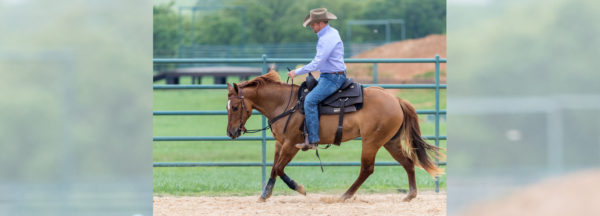
Q: My horse, a 4-year-old Missouri Fox Trotter, gives quite well when asked for vertical flexion at the standstill, walk and trot. However, when I put him on a loose rein, his head and neck come up more often than not. I’ve heard you say that if a horse’s poll is above the saddle horn, then you are in trouble. So my question is, is this due to his breed or do I need to spend more time on lateral and vertical flexion? – RSapp341263
A: When I put my horses on a loose rein, I don’t care where they carry their heads. If they want to throw their heads up and point their noses to the sky, that’s their business. What I do care about is when I pick up on the reins with a feather-light touch, will they come back to me? If the answer is no, then I’ve got work to do.
The horses I ride are Quarter Horses bred to be reiners and cow horses, so they naturally carry their heads level with their withers. The last time I checked, Missouri Fox Trotters aren’t built that way. So it’s completely natural for your gelding to carry his head high. My Quarter Horses aren’t going to gait down the trail, and your Fox Trotter isn’t going to travel around with his head level with his withers. There’s nothing wrong with that – we have two different types of horses.
You have heard me say that if a horse’s poll gets above the horn, you’re fixing to get into trouble. That’s something I learned from Ian Francis, and it’s absolutely true. What he meant by that and what I mean when I say it is think of all the times you’ve ever gotten into trouble on a horse. The horse bolted, he reared, he spooked … in all of those scenarios, where was the horse’s head? Sky high! Except for bucking, when the horse buries his head between his knees, when a horse does any sort of scary, dangerous behavior, his head goes up.
When you teach a horse the Method and work on softening and suppling his body, he naturally carries his head lower and when you ask him to give to the bit and soften, he does so immediately. This is true even when he does get startled on the trail or acts up. As soon as you pick up on one rein to guide him or correct him, he comes back to you. A horse that is stiff and resistant throws his head in the air and runs through any pressure you apply to him. And that’s when you’re fixing to get into trouble.
